

A high point of rock: this track, which closes Led Zeppelin’s fourth album, embodies a sonic revolution. Recorded at Headley Grange with the Rolling Stones Mobile and at Island Studios, it features a massive drum sound that has served as a model for generations of musicians and producers.
Practical goal: understand John Bonham’s groove, prepare a suitable kit, recreate an ambient recording, then process and mix the sound to achieve that monumental result without overdoing the reverb.
What you will learn: a clear method for creating a spacious, lively, organic drum sound—slower tempo, room microphones, room compression, stereo limiters and short Binson Echorec echoes—all integrated in the style of Jimmy Page.
To learn more about John Bonham and his legacy, read the John Bonham profile.
Why this track became a benchmark for rock and drum production
This track is often cited to show how percussion can become the soul of a song. Here, the drums do more than accompany the music: they define its identity.
Led Zeppelin, John Bonham and his distinctive standing
John Bonham embodied controlled power. His timing and touch gave the kit a weight and breath that went beyond a simple rhythm part.
A finale for the fourth album (1970–1971 sessions)
Recorded between 1970 and 1971 to close the fourth album, the track was designed as a monumental finale. The band thus created a contrast with the album’s other tracks.
From rock break to sample source in the 1980s
This drum passage became a break prized for its texture. From the 1980s onward, hip-hop producers incorporated it into sample libraries. Today, it can be heard in hundreds of sampled tracks.
“The drum intro of the Gods” — Jason Bonham
- Balance across the kit and a sense of space.
- Impact and heaviness that work in a loop.
- Example: slowing it down to emphasize its rhythmic weight.
| Strength | Effect | Modern use |
|---|---|---|
| Natural ambience | Sense of a room | Convolution / impulse response |
| Precise timing | Clear pattern | Sampling / looping |
| Weight of the transients | Impact | Slowing / filtering |
Understanding the essence of John Bonham’s groove
The pulse comes from the way it breathes: powerful hits, tiny variations and a consistent touch give every bar an organic movement.
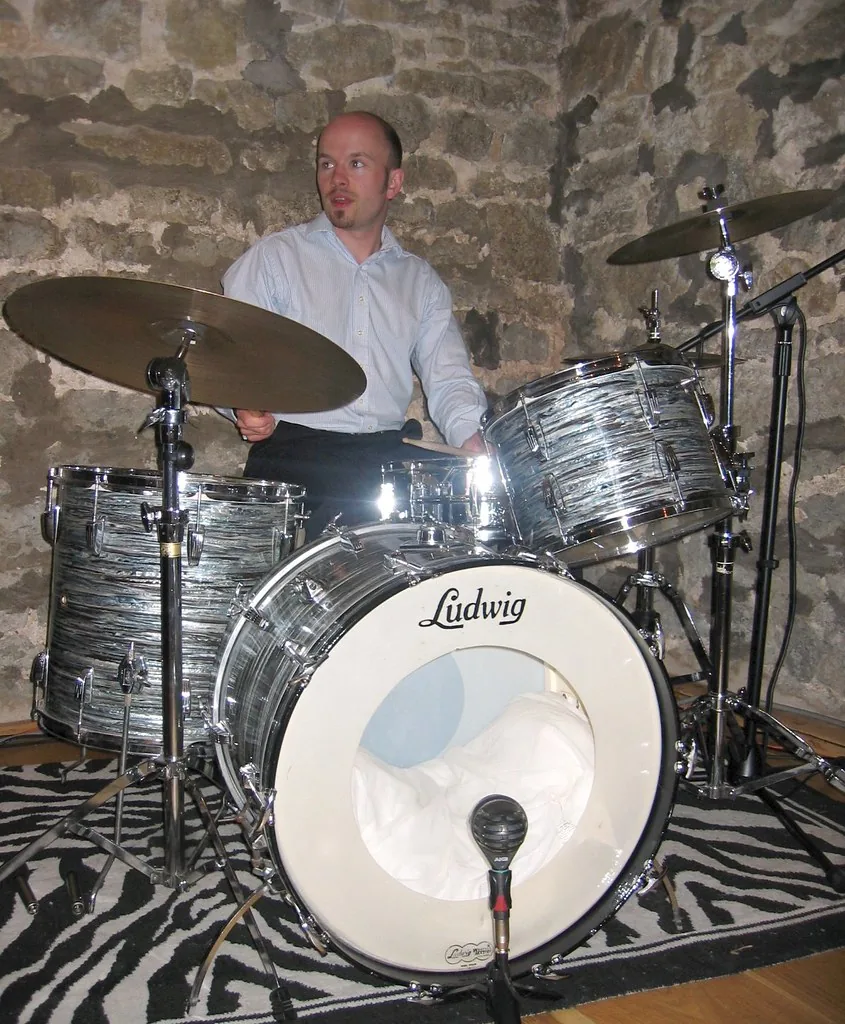
The “organic” pulse: power, breath and an earthshaking steadiness
Its strength lies in small differences, not metronomic perfection. The dynamics evolve naturally, creating a constant sense of forward motion.
How a slower production tempo adds weight
The band recorded at a faster tempo, then slowed the take in postproduction. This thickens the texture, lengthens the transients and makes the sound muddier without sacrificing definition.
What the pattern does—and does not do: simplicity, space, impact
In practical terms: kick drum on the strong beats, snare on beats 2 and 4, and a restrained hi-hat between them. The space between hits matters as much as the hits themselves.
The pattern does not pile on fills or cymbal strikes. That restraint creates tension and leaves room for the vocals.
| Element | Role | Effect to recreate |
|---|---|---|
| Kick drum | Rhythmic foundation | Clear placement, controlled transients |
| Snare drum | Backbeat marker | Clarity and a sharp attack without overplaying |
| Hi-hat | Textural support | Subtle, without dominating |
Prepare your kit and playing to approach John Bonham’s drum sound
Before recording, tune the kit so it breathes with the room. Start by listening to the space, then adjust the heads and tuning. A balanced kit makes the engineer’s job easier and brings the whole sound to life.
Tuning and sustain: aim for a cohesive kit
Tune the toms in a logical progression. Avoid having one tom project more than the others. Look for controlled sustain: long enough to give the sound body, but not so long that the attack disappears.
Stroke and dynamics: a huge snare sound without forcing it
Work on the consistency of your strokes: the point of contact and stick angle matter more than brute force. Vary the dynamics over a few bars instead of simply hitting harder.
Cymbals and hi-hat: keep the groove clear
Choose cymbals that do not ring excessively. Control your right hand and striking angle so the hi-hat supports the pattern without muddying it.
Common mistakes and a testing routine
- Too many close microphones that overwhelm the room sound.
- Aggressive gates or transient processing on everything.
- A kit that is too dry, with no convincing room ambience.
Routine: play the pattern several times, listen from a distance, then adjust the kit before any studio processing. This sound comes from real work on playing and placement, not a miracle plugin.
| Element | Goal | Practical advice |
|---|---|---|
| Toms | Progression | Tune in logical intervals with controlled sustain |
| Snare drum | Massive attack | Centered strokes, steady dynamics |
| Kick drum | Low-end clarity | Audible attack, minimal damping |
| Cymbals | Rhythmic support | Choose mellow cymbals; control your hand and striking angle |
Recreate the Headley Grange recording: the sound capture that changes everything
The Headley Grange recording turns a simple drum kit into a vast sonic sculpture. The hall acts as a natural amplifier, with long reflections and broad diffusion that reshape every attack.
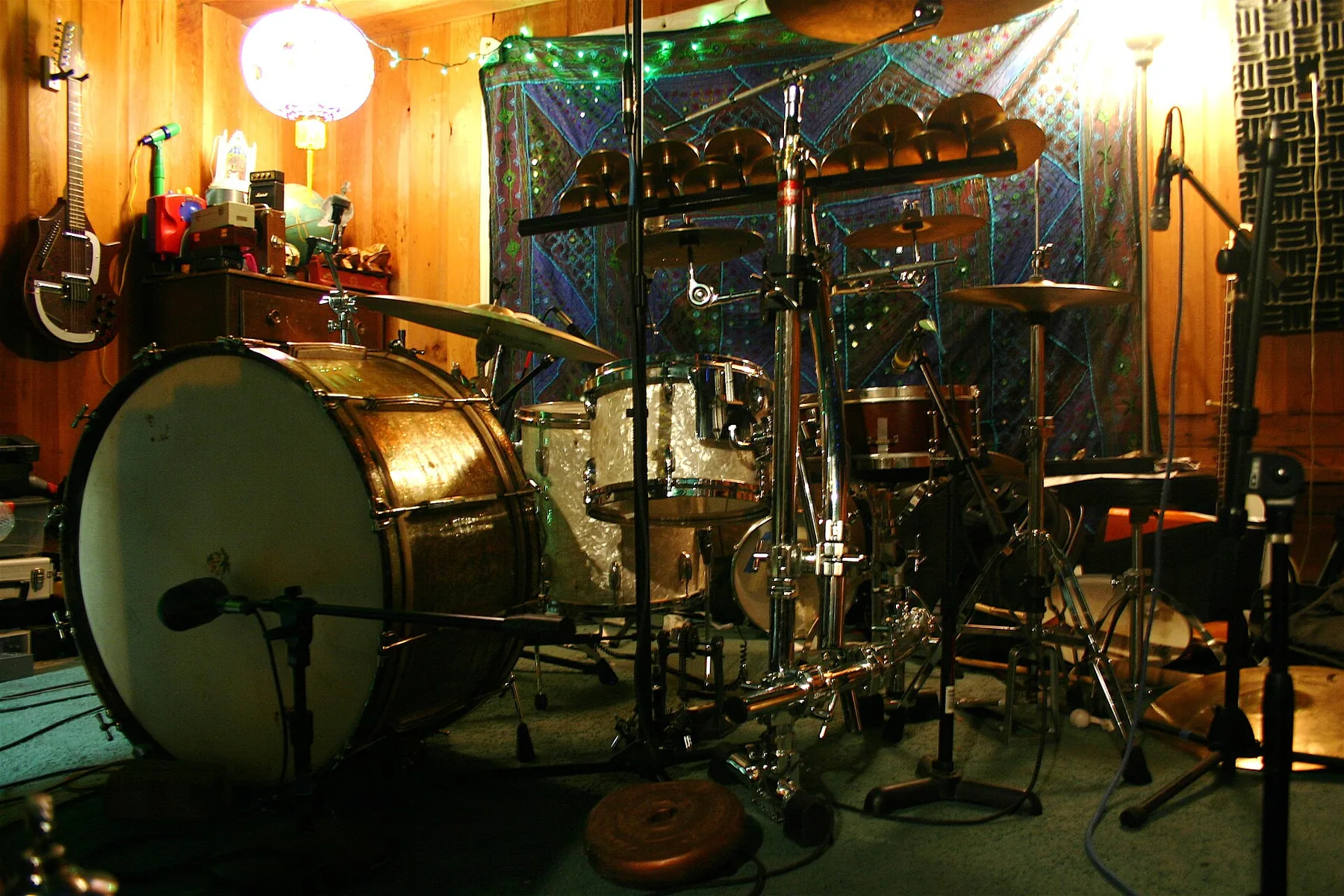
The famous hall placement and the stairwell principle
The stairwell principle: the stairwell and entrance hall reflect the kit’s energy. These reflections create natural sustain and a sense of space that a recording booth cannot provide.
Two high M160 room microphones: distance, height and angle
Two Beyerdynamic M160 microphones are suspended above the first floor. They capture the snare, toms and cymbals as a balanced whole.
Angle and distance control the bass and low-mid response. A small change in microphone placement alters the result more than equalization does.
Why removing the kick microphone can make the sound bigger
Andy Johns removed the close kick recording to avoid a single focal point. The low end is built by the room, creating a more convincing sense of size.
Routing and capture: two channels to the Rolling Stones Mobile
The recording setup was minimal: two room channels sent to the Rolling Stones Mobile. This approach demands a good balance at the source and limits changes in postproduction.
A modern alternative: simulate a large space in a home studio
If you do not have a large room, record the ambience of a real space—a corridor, garage or hall—then blend it with a large-room convolution.
Another option is to reamp the ambience through a speaker and record it with a distant microphone. Move the kit in 20 to 30 cm increments when testing placement: the change often affects the low mids and timing coherence more than a plugin does.
| Element | Effect | Advice |
|---|---|---|
| Stairwell | Long reverb | Test several heights |
| M160 | Capture of the whole kit | Suspend above the first floor |
| Routing | Only two channels | Send to the mobile studio or record in stereo |
Compression, limiters and echo: the “secret” after recording
The final mix sculpts the kit’s space and breathing. The recording provides the raw material; processing creates a monumental sound without betraying the attack.
Room compression
Goal: bring out the tail of the natural reverb and make the room sound denser.
Set a fairly slow attack to let the transient through. Choose a release timed to the tempo to avoid uneven pumping.
Use a moderate ratio (2:1 to 4:1) or parallel compression to retain depth. This gives the sound more breath and urgency without crushing the hits.
Stereo limiters
Andy Johns used two limiters in stereo to control peaks and stabilize the room image. They raise the perceived level while preserving the sound’s breadth.
Apply gentle processing: a cautious threshold, short lookahead and limited makeup gain. In the studio, this keeps the room from dominating the mix.
Echo and “canyon” slapback
A short Binson Echorec-style slapback adds a spatial signature. A short delay, low feedback and low-end filtering prevent muddiness.
Use echo sparingly to add depth without turning the drums into an effect. Jimmy Page often used this vintage effect, which contributes to the illusion of space.
| Element | Typical setting | Expected effect |
|---|---|---|
| Room compression | 10 to 30 ms attack, release timed to the tempo | More audible reverb tail, increased density |
| Stereo limiters | Short lookahead, moderate threshold | Peak control, higher perceived level |
| Slapback echo | 80 to 180 ms delay, low feedback | “Canyon” slapback, depth without muddiness |
Caution: too much compression flattens the room ambience, softens transients and can make the hi-hat harsh. Make these choices to serve the scale of the sound without masking the other tracks.
Integrate the drums into the mix in Jimmy Page’s style
To start a Page-style mix, let the drums occupy the room’s space. Andy Johns summed up his approach this way: room microphones for the drums, close microphones for everything else.
Key principle: room microphones for drums, close microphones for the rest
Begin the mix by bringing up the drum ambience first. This foundation guides the placement of the other tracks.
Then add the bass, guitars, vocals and harmonica.
Balancing bass and drums
The bass can disappear if the room ambience generates too much low-mid energy. Look for presence between 80 and 200 Hz and add a little harmonic saturation.
Subtle sidechain compression on the bass, triggered by the kick, can help without sacrificing warmth.
Guitars, vocals and harmonica
Place the guitars as stereo double tracks and apply a high-pass filter below 120 Hz to leave room for the kick and snare.
For Robert Plant’s vocals, preserve a clear space in the midrange and automate the delay and phasing.
Use dynamic EQ and small volume dips on snare hits to help the harmonica coexist with the snare.
A monumental sound without muddiness
Control the low mids with suitable high-pass filters and create space with moderate reverb rather than a large boost in bass.
To explore playing and recording techniques further, see a drum lesson.
| Problem | Solution | Expected effect |
|---|---|---|
| Buried bass | Harmonic saturation and gentle sidechain compression | Presence without clashing with the room ambience |
| Overpowering guitars | High-pass filter, stereo placement | Energy without low-end buildup |
| Masked vocals | Midrange space, effects automation | Clarity and movement |
The track’s signature textures that strengthen the groove
Each verse gets its own sonic touch, reinforcing the track’s momentum. These textures create movement around a repeated drum pattern without breaking the trance.
Vocal phasing and changes from verse to verse
The phasing, created with a Fender Princeton and tremolo, changes in intensity with each verse.
This variation supports the story: it emphasizes certain words without obscuring the lyrics.
Reverse echo: the echo that arrives first
With tape, the track was reversed so the echo would precede the source. In a digital audio workstation, reverse the track and then record the reverb or delay to recreate the effect.
Tip: filter the low end of the reversed tail to prevent muddiness.
Harmonica, placement and its dialogue with the guitar
Robert Plant’s harmonica enters energetically and often answers the guitar riff.
Mixed slightly forward, it competes with the snare without overwhelming it.
The spiraling ending and headphone listening
The final version uses fuzz and effects to create a sonic spiral. The other elements remain steady to preserve the track’s weight.
Listen on headphones: notice how the effects build up and influence your perception of the tempo and vocals.
Putting the legendary groove and drum sound of “When the Levee Breaks” into practice in a digital audio workstation
Let’s move from the concept to hands-on work in a digital audio workstation.
Set the tempo in BPM: tap along to detect the pulse, then identify any drift in the take. Decide whether to work on a strict grid or preserve the small variations in the playing.
Recreate the slowdown: you have two options: stretch the drum track without changing its tone, or record at a faster tempo and then slow everything down to recover the track’s sense of weight.
Virtual room microphones
Choose hall or stairwell impulse responses. Set a predelay to simulate the distance between the microphone and kit. Keep the wet/dry blend realistic: the ambience should breathe without drowning out the close recording.
A typical processing chain
- Light corrective EQ: reduce 200 to 500 Hz if the sound is muddy.
- Parallel compression for density.
- Harmonic saturation for texture.
- Short Binson-style delay (80 to 180 ms) for slapback.
Automation and checklist
Automate a slight increase in room size and echo at transitions. Check the snare and kick transients, the ambience’s mono compatibility, low-mid control and the room’s breathing without an aggressive gate.
| Check | Setting | Expected effect |
|---|---|---|
| Transients | Gentle limiter | Attack preserved |
| Mono compatibility | Phase check from 0 to 4 dB | Stereo mix still works in mono |
| Low mids | 200 to 500 Hz | Less muddiness |
| Reference listening | Turn down the volume | Check whether the sound still feels imposing at the beginning and at low volume |
From drum break to sample: why it is everywhere (hip-hop and electronic music)
Some drum passages lend themselves to repetition and eventually help define entire styles.
Definition: a drum break is a section where the drums carry the main pattern almost alone. Unlike a solo, it keeps a steady rhythm, making it ideal for looping.
Why this passage works as a loop
Simplicity of the pattern, huge room ambience and pronounced transients: these elements retain their character even after filtering, compression or pitch shifting.
Examples of its use
Hip-hop and electronic music producers have sampled it from the 1980s to today. It appears in tracks by Beastie Boys, Dr. Dre, Eminem, Björk, Massive Attack and Depeche Mode.
Ethics and rights
This practice recalls a connection with the blues: Led Zeppelin eventually credited Memphis Minnie and Kansas Joe McCoy for elements of a 1929 song. If you use a sample, document its source and check what permissions you need.
| Action | Use | Result |
|---|---|---|
| Chopping | Short loop | Repeating foundation |
| Pitch / tempo | Slow down / speed up | Change of tone |
| Layering | Add individual sounds | Modernized sound |
To learn more about the history and techniques of drum breaks, follow this guide. Draw on the principles instead of copying a sample exactly.
Adapt this legendary sound to your style without copying it
To make this sound your own, experiment with space, attack and tempo.
A “modern rock” approach
Keep the timing and swing, but give the kick more impact with EQ and transient processing.
Reduce the overall reverb and move the room ambience into the background for a contemporary studio mix.
A “lo-fi / trip-hop” approach
Increase the room compression and add saturation to roughen the tone slightly.
Lengthen the echo, darken the sound and preserve the pattern to keep the feel of the groove.
A “live” approach and hybrid options
Onstage, recreating the same room is nearly impossible: monitors, acoustic constraints and volume change everything.
One solution is to use room samples, a convolution bus or reamp a signal sent into a small adjoining room.
| Adaptation | Key action | Effect | Example |
|---|---|---|---|
| Modern rock | Strengthen the kick, reduce reverb | More impact and clarity | Studio mix |
| Lo-fi / trip-hop | Room compression and saturation | Swampy ambience | Long, filtered echo |
| Live / hybrid | Room samples or convolution | Illusion of space in concert | Page & Plant in 1995, for example |
Final rule: aim for the intention—a monumental, organic sound—rather than a copy of the original recording.
Conclusion
Practical summary: this track illustrates a clear process: a simple, massive groove; a slower tempo; room recording at Headley Grange; then compression, limiters and short echo.
Key roles: John Bonham drives the pulse, Andy Johns captures the room, and Jimmy Page sculpts the textures. Robert Plant adds vocals and harmonica, while John Paul Jones supports the track on bass.
Culturally, the song draws on the blues and later inspired many sampled tracks in modern music.
Checklist to try at home: choose a space, place two room microphones, limit close microphones, use parallel compression, add a short slapback, and check mono compatibility and the low mids.
In short: work on the performance and the sound at the source > plugin magic. Explore other tracks and spaces to create your own version.