
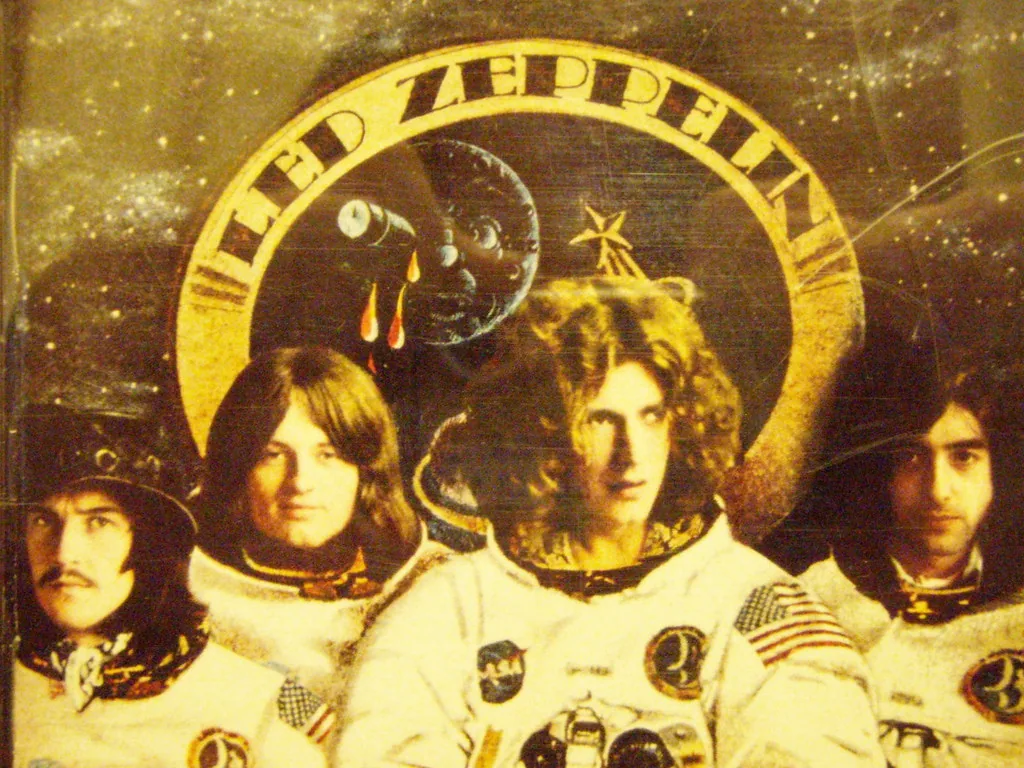
Why has this record inspired so much mystery? We begin with that question to understand why the fourth album became surrounded by riddles. Listeners remember its striking symbols and its cover without a printed title.
Our aim is to separate facts from interpretations. We will present the sources and context, then examine the esoteric and astrological readings that have fed theories about “ZoSo.”
In short, the term caught on because it is a convenient label, even though Jimmy Page has never confirmed it as an official name. This article places the album in 1971, explains how its cover became a point of reference, and follows a clear path through its history, the origins of its symbols, its songs and its legacy.
Who this is for: fans, curious rock listeners and enthusiasts of visual symbolism looking for a clear explanation in English.
Why Led Zeppelin IV still fascinates listeners more than 50 years after its release
Even decades later, this record fascinates through its mix of energy and mystery. It feels timeless because it brings together varied sounds without losing its coherence.
A timeless record spanning hard rock, blues rock and folk rock
The production blends hard rock, blues rock and folk rock into a rich sonic palette. Electric guitars alternate with acoustic passages, creating an unusual sense of movement.
The result: the music speaks to different audiences and refuses to be confined to a single trend.
A landmark album built on classics played live for years
Songs such as Black Dog, Rock and Roll, Stairway to Heaven and When the Levee Breaks were performed in concert for years. They became part of rock’s shared memory.
The band’s continued performance of these songs strengthened the album’s reputation and its place among the records recommended to anyone exploring Led Zeppelin’s work.
“It is a record that sounds both familiar and new.”
Essential facts about Led Zeppelin’s fourth album
To understand the record, let us begin with the concrete facts surrounding its creation.
Release date, running time, label and production
Released: November 8, 1971. Running time: 42 min 38 sec. Label: Atlantic Records.
Producer: Jimmy Page played a central role in production and maintained strong artistic control, despite the absence of a printed album title.
Recording locations and timeline
Sessions ran from December 1970 to January 1971. Recording took place at Island Studios in London and Headley Grange in Hampshire.
Moving between a studio and a secluded house helped shape the record’s atmosphere. Headley Grange provided a lively space for arrangements and experimentation.
- Quick facts: release date, running time, label and producer.
- Why these details matter: they reveal an organized production, artistic control and deliberate choices.
A note on approach: these facts provide a foundation before we turn to the imagery and interpretations that have made the album a landmark.
“An album without a visible title can still be carefully structured behind the scenes.”
An album with no title or band name on the cover: an anti-commercial strategy
The response to the mixed reception of the third album was deliberately silent and provocative. After the reception of Led Zeppelin III, the band chose to remove the usual identifying details from the cover. The decision was meant to focus attention on the music rather than its promotion.
“Names and titles and all that stuff don’t mean a thing,” Jimmy Page said in explaining the idea. The principle was simple: prevent a title from shaping how people heard the record. Listeners would judge it without a label.
At the time, this was a risky move. The band had the backing of Atlantic Records, a major label concerned about commercial confusion.
Deliberate confusion and Atlantic Records’ role
The label distributed reproductions of the symbols to the press. As a result, several names circulated in the media. The lack of lettering created deliberate confusion.
- Context: a reaction to a mixed reception.
- Reasoning: refusing to let a title guide the listening experience.
- Risk: a bold approach for a major record label.
| Element | Action | Consequence | Related fact |
|---|---|---|---|
| Context | No title on the sleeve | Several competing names | Mixed reception of Led Zeppelin III |
| Artistic reasoning | Emphasize the music | Listeners judge without a label | Jimmy Page’s statement |
| Label’s role | Distribution of the symbols | Reproductions in the press | Internal controversy at Atlantic Records |
“Names and titles and all that stuff don’t mean a thing.”
Ultimately, this strategy turned the cover into a cultural puzzle. The lack of information gave people something to talk about.
Next: the following section examines the outer cover to explain why its image and symbols were seen as a kind of code.
The outer cover: the man carrying sticks and a clash of eras
An unexpected scene on the cover creates a visual contrast between past and present.
The scene shows an elderly man carrying bundles of sticks in a picture hanging on a crumbling wall. A modern city can be glimpsed behind it. The choice surprises anyone expecting a typical rock album cover.
A nickname given by the public
The figure soon acquired an informal name: Sticks or Man with Sticks. These nicknames arose from the image itself and from popular catalogues.
Rural life, the city and the passage of time
Without insisting on a single interpretation, the image sets traditional work against an emerging urban landscape. The contrast suggests a change of era and a shift between ways of life.
An image that invites questions rather than providing answers
The cover echoes the music: modern songs sit alongside traces of blues and folk. Instead of supplying an explanatory title, it invites listeners to form their own reading.
“The image establishes a mystery and prepares the viewer to look inside for answers.”
- What it shows: an old man, bundles of sticks and a crumbling wall.
- Where the nicknames came from: the image’s visual simplicity.
- Its role in the story: the cover becomes an open point of reference, rather than a key.
The inner sleeve and “The Hermit”: tarot, allegory and interpretation
The inner sleeve reveals a figure that invites silence and reflection.
The illustration depicts a solitary figure on a mountaintop holding a lantern. Rendered in black and white, the image immediately reads as an allegory. The figure’s stance suggests searching rather than display.
The Hermit and the lantern as a guide
The Hermit recalls the ninth major arcana card in tarot. It evokes an inward quest, light in darkness and a personal journey. Here, the lantern serves as a guide, not an explanation.
Black and white imagery that supports the visual story
Strong contrasts define the mountain, the figure and the flame. The composition encourages introspection and asks viewers to take their time, without imposing a single reading.
Why it matters: the inner sleeve completes the strategy of withholding information. With no title or clear guide, the Hermit offers a fitting clue while leaving listeners to make up their own minds.
“Explaining too much would have spoiled the adventure of listening.”
After this image, the booklet presents more concrete signs. They act as signatures in place of the usual information.
| Visual element | Interpretation | What it suggests |
|---|---|---|
| Solitary figure | Allegory of a quest | Introspection, withdrawal |
| Lantern | Guiding light | A search for meaning, inner clarity |
| Black and white | Visual contrast | Suspended time, a timeless quality |
The four symbols: their origins, purpose and placement on the sleeve and record
Each band member chose a sign to represent them on this unusual record. The idea was simple: a personal mark in place of a printed name. One symbol per musician thus serves as an artistic signature.
The signs appear inside the sleeve and on the record. Their physical presence makes them hard to overlook when handling the vinyl. Replacing the title and credits with these icons changes how people read the object.
A shared visual code
Listeners naturally looked for clues. The symbols take the place of names and invite interpretation. They turn the sleeve into something to investigate.
- The four signs at a glance: “ZoSo” is associated with Page, a geometric design with Jones, three circles with Bonham and a feather with Plant.
- Different origins: some came from books, while others were drawn.
- The result: these marks replace familiar identifiers and fuel speculation.
“The emblems serve as visual identity cards, making the object as much a message as a record.”
The next section explores why these icons were read as a code and how Jimmy Page sustained the ambiguity. For a review of the historical context and key facts, see also the fourth album.
Led Zeppelin IV: the meaning of its symbols and the name “ZoSo”
When information is scarce, people look for clues: the symbols provided a starting point.
The instinct to look for a “code”: a sleeve without words encourages listeners to interpret every drawing. The icons become the main evidence for their investigation.
Our approach: distinguish facts from speculation. We separate documented sources and known attributions from ideas that remain unproven, such as a comprehensive occult scheme or hidden messages.
One key fact is that Jimmy Page has never fully explained his sign. His silence keeps the mystery alive. “ZoSo” is a popular nickname given by fans, not an official translation of the symbol.
“Mystery often grows from the absence of an official explanation.”
What follows: the next sections examine each symbol separately before returning to the album’s title and its competing names.
| Type | What is documented | What remains speculative |
|---|---|---|
| Page’s symbol | A popular name used by fans | Its precise esoteric origin has not been confirmed |
| Other signs | Associations with skill, a trinity and Ma’at | Unproven astrological and occult readings |
| Conclusion | Documented sources and statements | Interpretations vary from case to case |
Led Zeppelin IV remains a record where fact and fiction meet. We will keep our reading measured, documented and critical.
Jimmy Page’s symbol: “ZoSo” and its enduring mystery
Page’s personal mark is intriguing because it offers no immediate reading. Among fans and in the press, its nickname quickly became a practical way to refer to a shape that is difficult to describe.
Why call it that if it does not depict letters?
Popular usage: “ZoSo” is a convenient name. It is not the transcription of a word written by Page. The label makes it easier for the media and collectors to refer to the sign.
The alchemical grimoire connection
The most concrete clue is Gerolamo Cardano’s Ars Magica Arteficii (1557), which contains a similar seal. This historical connection offers a possible graphical source for the design.
Saturn, Capricorn and an astrological reading
Some see the shape as an allusion to Saturn or Capricorn, Page’s zodiac sign. This hypothesis deserves caution: it rests more on associations than on direct evidence.
Occultism and Crowley: facts and fantasies
Page’s interest in esotericism and Aleister Crowley is often mentioned. Yet documents must be distinguished from extrapolation. The musician’s silence adds to the symbol’s aura without establishing what he intended.
“The mystery persists because keeping a secret was part of the record’s aesthetic.”
| Aspect | What is documented | Possible interpretation |
|---|---|---|
| Popular name | Fans and the media call it “ZoSo” | A convenient, unofficial label |
| Graphical origin | A similar seal appears in Cardano (1557) | A plausible historical lead |
| Astrological dimension | Suggested links to Saturn and Capricorn | A cautious, unconfirmed hypothesis |
A note on wording: cite sources, use terms such as attributed or possible, and avoid definitive claims about Page’s intentions.
John Paul Jones’s symbol: vesica piscis, skill and mastery
John Paul Jones’s sign stands out for its precise geometry, which is easier to read than some of the record’s other marks.
It shows a circle overlapping three interlaced vesica piscis forms. The drawing is crisp and almost mathematical, and its shape looks more like a design taken from a catalogue than Page’s sign does.
Origin and context
The symbol comes from a work often described as a book of runes. That choice explains its catalogue-like appearance: it resembles a sign selected from a printed source.
Meaning and role
In a common interpretation, the sign evokes confidence, competence and mastery. John Paul Jones is seen as the record’s musical architect: his bass and keyboards give the songs structure.
“Attributed” does not mean conclusively proven.
The attribution is well established, but careful wording still matters: this is a sign attributed to John Paul Jones. Each member chose an emblem to represent himself without a name, strengthening the band’s identity while making its promotion less personal.
John Bonham’s symbol: three circles, a trinity and a nod to drums
John Bonham’s emblem is instantly recognizable: three interlocking rings, easy to make out and free of elaborate esoteric effects. Its clarity has made it a frequent subject of discussion among fans.
A family reading: many interpret the circles as a father-mother-child trinity. This suggests a simple human image rather than an initiatory secret.
A musical reading: viewed from above, the shape can also suggest a drum kit, with the three circles recalling the arrangement of drums. This interpretation directly connects the symbol to Bonham’s instrument and central musical role.
Another frequently mentioned detail is the design’s resemblance to a beer logo Bonham liked. This possibility links the symbol to popular culture and the drummer’s personal taste.
- Three interlocking rings: a simple, memorable design.
- A family trinity: a common, human reading.
- A drum kit viewed from above: a direct link to Bonham’s instrument.
- A resemblance to a beer logo: a possible popular source.
“Bonham’s drumming is one of the record’s foundations; the icon affirms his place in it.”
| Aspect | Description | Meaning |
|---|---|---|
| Shape | Three interlocking circles | Clear, without elaborate esoteric effects |
| Human interpretation | Father-mother-child | A family trinity |
| Musical interpretation | A drum kit viewed from above | A link to the drums and Bonham’s role |
| Alternative origin | A favored beer logo | Popular culture and personal taste |
Overall, the symbol remains deliberately down to earth: it celebrates Bonham’s role in the band while remaining accessible. The next section turns to Ma’at’s feather, a more explicit mythological reference.
Robert Plant’s symbol: Ma’at’s feather and the search for truth
The feather chosen by Robert Plant brings together ideas of truth and a spiritual journey.
The design: Plant, the band’s singer and lyricist, adopts a simple image: a feather of Ma’at within an unbroken circle. The motif is recognizable even to readers unfamiliar with its background.
Ma’at, truth, justice and fairness
The feather refers to Ma’at, an Egyptian goddess associated with truth, justice and fairness. Here, it acts as a moral guide.
That meaning fits the album’s imagery of searching: the feather suggests a quest for meaning rather than a dogmatic statement.
The unbroken circle as an image of life
The circle around the feather symbolizes life, cycles and continuity.
The contrast between this gentle symbolism and the powerful riffs helps balance the reading. Plant’s sign is easier to “explain” than some of the others, giving listeners a point of orientation.
“The feather offers a point of meaning amid the music’s power.”
There is one further surprise: despite the principle of one symbol per band member, a fifth sign appears in the booklet. The next section looks at Sandy Denny’s contribution.
The little-known fifth symbol: Sandy Denny and The Battle of Evermore
The booklet contains a small surprise: a sign attributed to a guest singer. Readers focused on the outer sleeve often miss it.
The sign consists of three equilateral triangles meeting at their points. It does not appear on the outer cover but is printed in the booklet alongside the other marks.
Context: the design represents Sandy Denny, who sings on “The Battle of Evermore.” It is the only instance of a singer from outside the band appearing on one of its studio recordings.
- This confirms that the marks are more than decorative graphics.
- The fifth design extends the idea: each contribution receives a visual signature.
- Musically, Denny’s presence strengthens the song’s folk and medieval atmosphere.
“An additional signature shows that the symbols also acknowledged contributions from outside the band.”
This detail complicates the idea of a closed code and opens up the discussion. After the symbols comes the question that has preoccupied listeners: what should the album be called?
Why the album is called “Led Zeppelin IV” despite having no official title
Despite the lack of a printed title, people soon needed a name for the album so they could sell it, catalogue it and discuss it in the press.
Common names: following the numerical sequence led discographies to use “Led Zeppelin IV.” Atlantic Records favored practical terms such as Four Symbols and The Fourth Album in promotion.
Variations and nicknames
- Untitled or The Fourth Album in official catalogues.
- Runes, Four, ZoSo and Sticks among fans and in the press.
- Visual nicknames such as Man with Sticks, inspired by the cover image.
What Jimmy Page and Robert Plant say
Jimmy Page often uses “Led Zeppelin IV” in interviews. Robert Plant tends to say “the fourth album,” a phrasing that preserves its mysterious aura.
“The use of several names reflects both a commercial need and a deliberate silence.”
| Who | Name used | Reason |
|---|---|---|
| Atlantic Records | Four Symbols / The Fourth Album | Commercial clarity |
| Media & fans | Runes / ZoSo / Sticks | Practical names based on the imagery |
| Band members | Led Zeppelin IV / the fourth album | Personal usage, preserving the mystery |
In practice, “Led Zeppelin IV” became the simplest name to use. The other names persist across editions, countries and fan communities. With the naming question addressed, let us turn to the songs behind the album’s lasting reputation.
Key songs and their connection to the album’s imagery
These songs form a sonic story in which rural mystery and urban power answer one another. They extend the cover’s themes: images, symbols and textures find echoes in the arrangements and production.
Stairway to Heaven: mysticism, arrangements and myth
Stairway to Heaven builds gradually, combining acoustic sounds with electric tension. The Mellotron enriches its harmonic layers, and the solo, played on the “Dragon” Telecaster, helped its legend grow beyond the song itself.
Played extensively on the radio, it embodies the album’s mystical side.
Black Dog: a rhythmic signature and an anecdote
Black Dog features a complex rhythm and a riff devised by John Paul Jones. Its name also comes from an anecdote about a stray Labrador seen during rehearsals.
Reaching number 15 as a single in the United States, the song shows the power of guitar and drums within a tightly focused sound.
Rock and Roll: raw energy and a tribute
Rock and Roll is a direct nod to the genre’s history. Its straightforward structure and tempo put the drums at the forefront. It captures a raw energy made for the stage.
Reaching number 47 as a single in the United States, it remains a rock anthem.
When the Levee Breaks: blues, history and production
When the Levee Breaks reaches back to early blues and the Mississippi flood of 1927. The cover follows in the tradition of Memphis Minnie while transforming the sound through a remarkable drum recording.
The drums, recorded in a stairwell at Headley Grange, were treated with phasing and flanging effects to create a massive, distinctive sound.
Four Sticks, Misty Mountain Hop and Going to California: contrasts
These songs form a contrasting trio: Four Sticks explores complex rhythms, Misty Mountain Hop combines groove and atmosphere, while Going to California offers an acoustic, folk-inspired pause.
Their variety confirms that the album draws on sonic contrasts as much as visual imagery.
“Several songs endured on stage for decades, strengthening their status as classics.”
For more background on rock and the history surrounding these songs, consult this practical guide: a beginner’s guide to rock.
Success, legacy and key figures: from 1971 to today
Sales figures tell a story of longevity and worldwide impact.
Sales and certifications
A striking figure: more than 24 million copies sold in the United States and around 37 million worldwide. These totals place the album among rock’s biggest sellers.
In November 2021, the RIAA recorded a 24-times-platinum certification, reflecting the album’s commercial longevity across decades.
In France, sales exceed 1.1 million copies, confirming an appeal beyond English-speaking markets.
Charts, awards and critical legacy
The album reached number one in the United Kingdom and remained on the charts for a long time. It received a Grammy Hall of Fame Award in 1999, a notable institutional honor.
“Commercial impact and critical recognition together sustain its place in musical history.”
| Element | Figure or fact | Context |
|---|---|---|
| Around 37 million | Extensive international reach | |
| Certification | ||
| Recent RIAA recognition | ||
| The legacy is also evident on stage: several songs continued to be performed live, sustaining the legend for new generations and longtime fans. | Transition: |
The band’s strength lies as much in the music as in its carefully staged silence around the album. That strategy turned the record into something to interpret, where the absence of a title matters as much as any composition.We have separated fact from speculation: documented information about the signs, their attributions and Page’s deliberate silence remains distinct from occult interpretations. This care helps explain the record’s cultural impact.
The cover, the icons and the music express the same tension between tradition and modernity. Its major songs have carried the record through the decades and established it as an enduring landmark.
Instead of seeking a single solution, it is better to consider the whole: the images, signs and lack of text deepen the listening experience. If there is one point to remember, it is that the mystery served the music, not the other way around.To learn more about literary references in some songs, see the references to Tolkien
:
references to Tolkien
.
FAQWhy does the album still fascinate listeners more than 50 years after its release?